Mindie – Bridging The Gap Between Mainstream And Indie
July 14, 2010

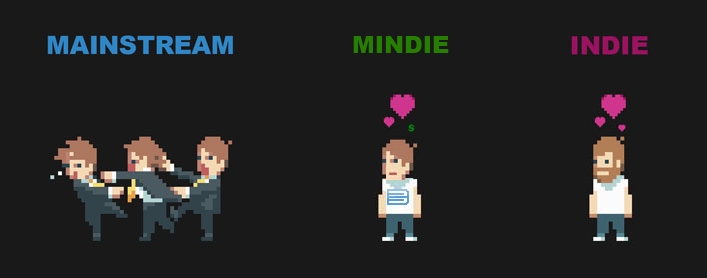
Mindie Game DeveloperI’m a mindie game developer and proud of it.  But what does that mean?  I’ve noticed a trend lately when it comes to indie developers.  It seems to be all or nothing.  You’re either Indie, with your beard and rebellious attitude or you’re mainstream with your suit and love of money.  Why does it need to be so black and white?  Am I the only person that wants to fit nicely in the middle, making deep and meaningful games that make a healthy profit?  Can I be the bearded guy in a suit, or the clean shaven guy in a polo shirt?  What’s wrong with wanting to be “mainstream indie”, or a “mindie” game developer?

Over the past few years the mainstream has moved further towards sequels, playing it safe and limiting creativity.  It seems indie game developers are reacting to this by becoming “more indie”.  A case in point is the IGF.  Many of my indie friends complain that it’s impossible to win the IGF without making a controversial game that has no chance of making money.  Surely we can find a middle ground between these two opposed views.

Let’s look at key parts of game development and see where Mindie developers fit into the mix compared to pure mainstream and indie developers.

ProfitsMoney is the root of all evil but the source of all Twinkie’s

Most indie developers I know don’t have the luxury of making games just for the love of it.  At the end of the day, we all need money to live.  Mindie developers are mindful of making a profit from their games but not at the expense of the game itself.  The current landscape of game distribution is the perfect time for this lofty ideal.  Digital distribution, micro-transactions and huge user bases on platforms like Facebook mean that we no longer have to make a boxed product that sinks or swims based on the first few months of sales.  This gives Mindie developers the freedom to flex our creative muscles and then find a sales model that fits our product.  There are many options to take opening up many more possibilities for game design and creativity.

CompetitionCompetition creates better products, alliances create better companies – Brian Graham

The general consensus is that indie developers don’t focus on their competition while mainstream developers are obsessed with them.  Where does the Mindie game developer fit in?  This time, we are closer to our indie roots.  While it’s important to be aware of the competition and create something new and interesting, it should not drive development.  Indie developers begin with their own ideas and creativity and adjust their plans based on competition.  Mainstream developers begin with their competition and adjust their plans slightly to create their own game.

Publishers/InvestorsTime is more valuable than money. You can get more money, but you cannot get more time – Jim Rohn

The traditional indie developer is defined by not having a publisher or large investor, hence the term “independent”.  They are usually self-funded or take on small amounts of angel investment.  The general consensus from mindie developers is that they would take on money, so long as it doesn’t water down their game.  This is often shown by their realistic expectations of money required rather than the “more is better” attitude of most mainstream developers.

Project SizeIt’s not the size of the dog in the fight, it’s the size of the fight in the dog – Mark Twain

Mainstream loves big, multi-million dollar games.  Every year the cost keeps going up.  Indie developers either through love, or more often than not, through necessity go for simple, small projects.  Mindie developers need to find the middle ground again.  Projects that are of a substantial size that they can make a profit while keeping development costs low at all levels of development.  From team sizes to feature lists, they focus on finding the fun with the least possible features.

ArtIf you think a game is ‘Madden 2008,’ then hey, games probably aren’t art – Jonathan Blow

Many indie developers make art.  Mainstream developers are skilled in the art of spending copious amounts of money making a game that is 10% better than the previous game or competitor.  Mindie developers are pragmatic.  They focus on making a fun, deep game and letting everyone else decide whether it’s art.  Pragmatism over pretentiousism*.

*Yes that’s not really a word, but neither is Mindie

Conclusion

So that’s my attempt to bring some unity between the mainstream and indie developers.  I look forward to seeing what the coming years bring for mindie’s and particularly in Australia where the collapse of the mainstream game development industry has left most of my friends turning indie in hopes of fame and fortune (or at least recognition and Twinkies).

What do you define as a mindie and are you one?

Share:
  • Digg
  • Reddit
  • Facebook
  • del.icio.us
  • DZone
  • LinkedIn
  • email

Find Us On Facebook

  • http://topsy.com/www.doolwind.com/blog/mindie-bridging-the-gap-between-mainstream-and-indie/?utm_source=pingback&utm_campaign=L2 Tweets that mention Mindie – Bridging The Gap Between Mainstream And Indie – Doolwind’s Game Coding Blog — Topsy.com

    [...] This post was mentioned on Twitter by Doolwind. Doolwind said: Mindie – Bridging The Gap Between Mainstream And Indie Game Developers – http://bit.ly/adreNe [...]

  • acron^

    Nice article but you paint mainstream developers in a less than rosy light. Don’t forget that commercial games aren’t created by suits, they are created by passionate and talented people who are also out there to have their vision realised. I work for a large British work-for-hire studio and the mindset amongst the troops is very much the same as your average Indie. They want freedom, they want creativity, they want players to love what they have created. Not every commercial developer is looking to be the next Bobby Kotick.

  • Doolwind

    acron-
    I was mainly putting out there the perception of what the mainstream games industry is like. I would classify some good “mainstream” developers as Mindie as well, it goes both ways.

    Having said that, I did stereotype a little and I agree that not all mainstream development shops are that bad :)

  • acron^

    Curiously, Doolwind, you talk about the games industry collapse in Australia – when did this happen? And how many developers were affected?

  • http://www.doolwind.com Doolwind

    acron-
    It’s been happening over the past 3 or so years. The big ones to go were:

    Auran – 70 people (where I was working up until 2 weeks before they closed)
    Pandemic – ~40 people?
    Krome – Laid of % of their staff. They are still around now and going strong.
    Interzone – Unsure of numbers, they were the other side of the country, but I knew at least 1 person there when it happened
    Fuzzyeyes – 20 or so (where I used to work)

    That’s all I can think off of the top of my head. That may not seem like much compared to larger countries like the US, but that was a large percentage of developers. As a guess, I’d say 50% of the industry has been let go over the past few years.

  • http://Arowx.com Arowx

    What about looking at the game developer space as a 3d space with an axis for team size[x], financial independence[y] and creative freedom[z]?

  • http://www.doolwind.com Doolwind

    Arowx-

    That’s an awesome idea, I’ll see what I can do :)

  • Simeon

    As a veteran game developer I agree whole heartedly with acron. In fact, I have never met a developer who is anything other than creative and passionate.

    Your post comes across as naive, have you actually worked in making “mainstream” games?

    However, I have rarely crossed publishers who are all about the money and the developer is just there to be used to make a quvik buck But that is the nature of non-indie development where you engage a publisher. The vast majority are amazing to work with but there are a few bad apples who get the bad press.

  • http://www.doolwind.com Doolwind

    Simeon-
    While most game developers are creative and passionate, I have met my fair share that are not, and they don’t usually last very long. This post is not a slight against developers, it’s more a look at the bigger picture of titles everyone is throwing around within the industry.

    Yes, I’ve worked in the “mainstream” games industry both with and without publishers for 7+ years. I now do part-time contract work for a mainstream developer while running an indie company.

    Perhaps the situation is different for us in Australia, as many publisher-developer relationships are highly focussed on money over creativity. This is both from my own personal experience and friends within other mainstream companies.

  • http://morethanjustgames.wordpress.com Newmixtape

    Nice article. I’ve been rolling this same thought around for a while myself and I think you summed up what I’ve been thinking all this time.

    I’m fairly new to the game development business, but I’ve always felt my mind set landed somewhere in the middle of mainstream and indie. Mindie sounds like it fits me pretty well.

    Thanks for the read.

  • http://morethanjustgames.wordpress.com/2010/07/16/hi-im-mindie/ Hi, I’m Mindie « More Than "Just Games"

    [...] made up title comes from an article written by Alister Doulin that sums up some of the things I’ve been thinking about lately [...]

  • http://www.samwhat.com/ Sam Sweeney

    Thanks for the article!
    I’m very interested in the indie scene, especially here in Australia; I hope to dive into it myself, soon.

    It seems that now there are many different platforms and places to launch or distribute indie games, where as before you had to go through commercial roots to get there.

  • http://www.diygamer.com/2010/07/indie-link-roundup-2/ Indie Link Round-Up: I am who I am | DIYgamer

    [...] Mindie – Bridging The Gap Between Mainstream And Indie (Doolwind, Alistair Doulin) “I’m a mindie game developer and proud of it. But what does that mean? I’ve noticed a trend lately when it comes to indie developers. It seems to be all or nothing. You’re either Indie, with your beard and rebellious attitude or you’re mainstream with your suit and love of money. Why does it need to be so black and white?” [...]

  • http://rampantgames.com/blog/?p=934 “Mindie?” No Thanks

    [...] Doulin writes on both Gamasutra and his own blog (they are the same article) about bridging the gap between mainstream and indie game [...]

  • http://wisnoskij.blogspot.com/ Jonathon Wisnoski

    Well regardless of which is better I think that we can all agree that they are all very different and it really is a sliding scale from mainstream through mindie to indie.

    And there are great games out there that only mindies could create, as well as examples that fall into the other 2 categories as well.

    And while a general statement like mainstream games are horrible is overkill in general mainstream developers have strayed far from entertaining and artistic games.
    And I am sure that many mainstream devs are super talented but that means very little when you do not have creative control.

  • http://gamerboom.com/archives/36094 中间派独立开发者:主流与独立的平衡 | GamerBoom.com 游戏邦

    [...] of my friends turning indie in hopes of fame and fortune (or at least recognition and Twinkies). (Source: Doolwind’s Game Coding Blog) 分享到: QQ空间 新浪微博 开心网 [...]