What Auran Did Wrong

January 12, 2008

Auran Developments went into liquidation late last year. Many of us saw it coming for at least a few months, if not years. Below are my personal thoughts on why Auran went bust. I’m writing this to try and help other struggling software or game development stduios from ending up in the same way.

To get the legal stuff out of the way. When I mention “Auran” I’m talking about Auran Developments. That is the company who hired me, and the only one I ever really had any interaction with. Auran Games et al. are still running fine and have nothing to do with the following article.

Listen

The first main problem was that Auran wouldn’t listen to anyone. This was the core problem I see as its tentacles really reached out and touched every part of the company. I don’t know how many people would talk to me about how they’d made a suggestion months or years earlier only to have it ignored and then the exact problem they foresaw coming up. While it’s important that people high up are the ones making the decisions to direct the company, they also need to know where their weaknesses are and seek advice from the best people in each field.

When I started at Auran there were a LOT of extremely talented people that had thoughts on the direction the company should take. Unfortunately, most of their requests were ignored, and the majority of people simply left the company as they could see that the wrong decision was being made. By listening to people who are skilled in their particular field, they would have been able to keep these skilled people on, further increasing the company’s chances of success. The bottom line is that good people have good advice, and not listening has a twofold problem. The company fails because they don’t do the right thing AND they lose the good people giving out this advice.

Keep Good People

This leads into the second problem, the number of great employee’s I saw leaving was astounding. This also has a snowball effect because when great, senior, people leave everyone below them wonders if there’s something they don’t know about. For me, the first sign that something wasn’t quite right was when one of the star graphics programmers informed Auran he was going to leave if he wasn’t put on something interesting. This guy (while never admitting it himself) was basically Carmack 2.0. He is the kind of person that good companies would give almost anything to have on their team. However, at Auran, they just let him slip away even after giving them a direct option to resolve the problem. The other problem was when the three leads (programming, art and QA) all resigned within a couple of weeks of each other.

Be Transparent

The other main problem was the lack of transparency and communication. It’s vital, for any software project that crucial information flows down to “the trenches”. There’s nothing worse than reading in a magazine or website that the company is in trouble, or that it’s just received another round of funding from investors. Many companies have this problem, where you need to be on the grape vine to find out information that directly affects your job and your life. This was compounded at the end when people were literally sitting around waiting to find out if they were fired or not.

The transparency part comes from sharing the vision and direction of the company with all staff members. Most of us had to simply guess what would be happening in the coming months. Part of this problem comes from having the wrong people too high up in the chain of command. As soon as you have less qualified people above more qualified there’s going to be both conflict and misdirection with the company.

The B team

I was part of a second team at Auran (not Fury). Let’s call it the “B Team”. This team worked really well together, produced a great product in a short time and was ready to move onto producing more great products. What’s the logical step Auran should have taken? Good companies know that good people are hard to find (and even harder to replace). Good teams though, they are like the holy grail of software development. If you have a good team, you do anything you can to hold onto it, foster it and mainly, make a crap load of money from it.

Not so at Auran. We were broken up, forced to work on crappy projects that we would rather resign than work on (as was the case in my situation). A number of people pleaded with Auran to keep us together and to make money from us. That’s all we wanted to do, work together in a great team making money for Auran. It seemed this direction was not the same as Auran’s.

Don’t Keep All Your Eggs In One Basket

The next big issue was focussing on one single product. I’m not going to get into whether Fury was a good game or not. Either way, it is too much to risk an entire company on a single game. I heard this almost daily from people around the company, but no one would listen. Generally, when an age old proverb is written about something, it’s a good sign that you should heed its advice.

The games industry is a hit driven industry which means there’s a great chance you won’t succeed off a single product. Sure, there’s a chance you could make it to the big time, but there’s a far higher chance all your employees could be jobless just before Christmas.

Software Development, It’s Hard!

Finally it just comes down to software development. Software Development is really hard. Personally, I love it; I’ve found what I want to do for the rest of my life. I’ve also come to the conclusion that I’ll spend the rest of my life trying to do it perfectly, and never succeed. There’s no “silver bullet” and you certainly can’t treat it like running a regular non-tech company. While software development is relatively young, compared to the other schools of engineering, it’s also full of great techniques. Unfortunately, most of these weren’t employed at Auran. Good games development practices weren’t employed either. I’m a strong believer of making a game fun, then working out how to finish off the “extra bits”.

Conclusion

So that’s what I see that Auran did wrong. I don’t blame any individual people and I don’t think that anything can be gained from doing so. I loved a lot of my time working at Auran; it was the dream company I’d wanted to work at since Dark Reign came out when I was in high school. I did a lot of soul searching when I decided to resign, and it made me really depressed to think of what could have been.

If I had to put down one single moment when I knew it was over, it was a lunch time in September sitting in one of the back rooms with Shauno, the artist on my team. I was flicking through the booklets of Dark Reign with every newspaper clipping relating to it. I remembered back to when I read those very newspapers/magazines 10 years earlier and what I had dreamed working at Auran would be like. I compared it to what was happening at the time, and the decision was pretty much made for me. I’d like to thank everyone I worked with at Auran, and I hope that others can learn from the mistakes made and we can see the Australian games industry flourish in the coming years.

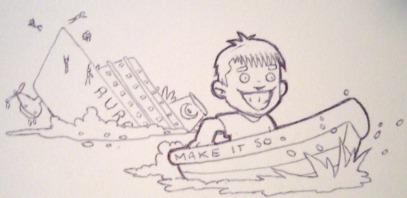
The picture for this blog was done by Shauno again. It’s actually based off the original picture he drew for my farewell card when I resigned.
Share:
  • Digg
  • StumbleUpon
  • Slashdot
  • RSS
  • del.icio.us
  • Facebook
  • Sphinn
  • Mixx
  • E-mail this story to a friend!
  • Print this article!

Find Us On Facebook

21 Responses to “What Auran Did Wrong”

  1. Hmm…In some ways I believe that in this rare but appropriate case that blaming individuals might actually be a good thing.

    Unfortunately most of these individuals include the CEO and the lead designer. Neither of which is ready to accept responsibility for what is quite clear to the world as their own mistakes. Ego and self appraisal overshadow any guidance offered. They labor under some insane view that all the reviewers are idiots and that somehow the game is incredibly awesome but nobody understands it. The problem being that regardless of reviews…nobody bought into their psychosis. Upon that comes the cry that it’s the publishers fault! How many epic failures must one suffer before an act of contrition?

    If the advice and experience of talented individuals had been heeded it would be substantially less as a trainwreck. Still, due to extremely flawed fundamental processes in design and execution it would STILL be a failure. Fury as a whole was a dismal reflection on the inexperienced and theoretically experienced souls who grasped and would not relinquish control. Under no circumstance would they heed warning; including the lack of attraction for major publishers. The attempt to force publishers to believe fury was awesome became a horrible and disgusting distortion of reality which to some degree they must have believed themselves. To the degree that they believed in it, they were fools. To the degree which they did not, they were dishonest.

    People were forced to adhere to lies and misdirection. The entire design and QA process became a joke reinforcing a horrible delusion which in the end proved to be the psychotic end. Now, the project languishes in its own asylum pen banging the last of its sane brain cells against padding. Eventually those last few talented individuals will be forced to rehabilitate a truly demented situation or give it up for more reasonable existence. Under no circumstance can Fury be considered a success regardless of how far it proceeds from this point. People lost their jobs. There is no gold star. There is no cookie. There are no Fury points.

  2. spot-on dooly, seriously I think i felt the same way a few months after i arived.

  3. I agree whole-heartedly. I was like you, Alistair; my fascination with Auran came about after playing Dark Reign. After that I knew I wanted to work for Auran. In the beginning it was great, I was greeted with a basket of goodies and welcomed aboard with free lunches, softdrinks and fruit. It seemed like an awesome place to work.

    As the years progressed (I was there for 7 years), I tried to ignore the people that left, putting my head down and carrying on with the coding. Things really hit when our Producer on the B team was removed from his position.

    He was the best producer we’d ever had. We were highly motivated and he was able to understand the way we worked and simply supported us in any way possible. It sure was loads of fun before he left :)

    It’s definitely the team dynamics that can make or break the project. From that point onwards it seemed we were a forgotten team. A lost bunch of nomads, who’s nearest recognition was the rubbish tip, if you and Shauno remember ;)

    Not to worry though, there are plenty of other studios out there, willing to grab some refugees and help them on their way!

    Anyway, its been great experience and I’m taking with me everything I’ve learnt about how not to do things. Maybe one day we can once again form together in a similar team and proceed to make great games.

    Cheers!

  4. Ohhh, you can see me waving in the window of that sinking ship.

  5. Thanks for the post, mate, it was an interesting read.

    Unfortunately, I have to say that even though I come from a different part of the Australia development industry, many of the things you mentioned sound very familiar. In fact, some of the things you mentioned have even been levelled against me, as accusations, though under different circumstances. The reasons and the whys, I won’t go into but suffice to say, given the prevalence of the same stories appearing again and again, I have worry that the solutions may not be easy.

    There is a problem in the Australian industry. Something deep, dark and ugly; and everywhere. It appears when the going is hard, and the going is hard now because the Australian industry is saturated. It’s tricky to find a competitive edge to offset the various difficulties of making a game down under (particularly with the weak US dollar, and the potentiality of the rise of eastern European developers). Perhaps the GDAA will be able to bash out a solution for us one day and allow the industry to continue grow, but right now we seem to be hitting our limit. There’s too little investment and it’s inevitable that economic fluxuations will lead to studio closures.

    I’ve been mulling over what “the problem” is for a long time, but one simple idea that has interested me lately is that perhaps what we lack is the legacy of past successes that you find in the US and the UK. That is, these industries when through the growing pains of inventing a stable development process and sophisticated skill labour force while games were still small and easy to make. They then progressed onto making the blockbuster on the shelves now.

    Meanwhile, Australia was not about to form an established industry during those formative years. After all, there were only a few successful Australian games–the Hobbit, Way of the Exploding Fist, Dark Reign, KKND, Shadowrun. The was not enough to build the methods and the “human capital” we see in the US, particularly since many of the people who made those games have left the industry. All in all, the US industry, particularly on the west coast where is a great density of developers, has become a complete different place, far removed from our idea of the industry. And yet, here, we have to complete on the world stage, so we must, with less capital and less efficiency, attempt to build better (or, at least, equivalent) products. As you say, it’s hit and miss. You can’t survive with inferior products, the sales figures drop off too rapidly–if you don’t get in the top 5 games, you may not make back the cost of development. And every time that happens, publishers become less convinced that Australia is a good place to invest.

    In other words, maybe what we need in the Australian industry is to return to simpler games for the time being, and develop that legacy–just as it was developed overseas. There are methods of doing that popping up–Xbox Live, WiiWare, indie distribution, what have you. That doesn’t sound particularly inviting though, kind of takes the edge off the fun of it.

    Ah, well. Perhaps, in a round about way, one of the things that might help one day is the arrival of an Australian publisher. We’ve had Australia arms of foreign publishers run here before, but not ones with Australian money, incentivised to grow the local industry. The publisher/developer relationship is an oddity in our industry, but an important one. I’m convinced that it can’t work correctly over the width of the pacific (or to Europe), and it doesn’t do so to our detriment.

    Alternatively, we can slog it out until worldwide methods stablise, and the industry slows down it’s innovation. It’ll get easier. In five years, ten years… The industry will be different, but it’ll be easier.

    Anyway, my rambling doesn’t really the freshly ex-Auranites out there. Best of luck to them, and I hope those that did lose their job are finding places new and exciting to work.

  6. DJ~

    Thanks for the insightful comment. I haven’t spent a great deal of time thinking about a strong solution to our problem, you’ve inspired me to spend some time contemplating it. I think we have issues at a number of different levels within the Australian games industry. I spoke mostly of the more specific studio-level problems, and I’d love to one day run my own studio to “do it right”.

    What I haven’t thought much about is the higher level problems you touched on. Australia really hasn’t put out a huge hit in quite some time, and when we do, they seem to stand out alone and aren’t taken advantage of. Bioshock is a great example. It’s an excellent Australia game, however its the sequel will be made offshore. This is obviously because there’s a parent US company involved, but it would do our local industry so much better if we saw add-ons, sequels and possibly a whole franchise grown from locally. Some studios have tried for this and I haven’t seen a great success yet.

    Thanks for inspiring such thoughts, and I look forward to sharing what I can come up with.

  7. Was SWAT4 made here? I understand that was a smash success.

    I had the option to work for a little gaming studio in Canberra, but took a dev job for a Security organisation as a solutions developer instead.

    Many of the problems listed here also exist in the enterprise world. However, gaming has more demand for jobs. With more demend comes higher quality in staff. You see, in security, we hire nearly anyone who has any kind of PKI XP and pay them far to much. The gaming industry is hard to get into. I tried very hard to get a place after graduating and it was only after a few years writing simulator game for defence and freeware zelda clones that I had any chance.

    So I guess, it must be great to work in a developement environment with people who know how to code and are passionate about their jobs.

    Anyway, I brought Fury. The EB games guy said that I was first… lucky me.

  8. [...] has posted his personal views on the closure of Brisbane-based developer Auran late last year. » What Auran Did Wrong __________________ I don’t know Butchie [...]

  9. I have to put another vote in for ‘I wanted to work at Auran because of Dark Reign’ so having the opportunity to do so was like all Christmas’ come at once. Though optimism soon gives way to despair when you reach the end of a project and find yourself put on something you have no interest or belief in while always being told ‘We’ll have a new project for you soon’.

    Your analysis is spot on though. As you probably heard me say many a time, I came from three years of experience with start ups (yes, I class Auran as a start up because it was privately owned) and the things you outlined are pretty much page one of the ‘How to make it work and not go under’ manual. Page two says don’t turn to venture capitalists, but that’s another story. ^_^ Let’s just hope that lessons have been learned and the new ‘trimmer’ Auran doesn’t repeat its own mistakes, though knowing that what is now Fury took 10 years and quite a few complete redesigns doesn’t fill me with confidence.

  10. I find it really sad when this kind of thing happens with any company. It’s so hard when a talented group of people have to disband due to poor senior management, but on the upside it stands as a powerful lesson to all. I’m sure all of the artists and programmers that sadly are out of a job will be able to find work and will be far more aware of what to watch for in a company. Good luck to all of you. BD

  11. I agree with a lot of what is being said though I’m not sure what you’re getting at Cough with your comment about the QA process. I worked for Auran in the last year before downfall. Yes I was QA.

    The biggest thing that frustrated me about the whole process was this. When I started there was 4 of in QA for a, and I use the term loosely, MMO. We were writing test cases and collision testing and when we had time, balance. I worked through Christmas of 06 to get some balancing right. Finally in the new year we got some more recruits. Or ranks swelled to 10 then 12. But this was now where near enough.

    Since the Alpha stage in January last year we virtually stopped all proactive testing. It became more and more reactive testing. Problems couldn’t be anticipated because we didn’t have the time or the resources to test for them. The major thing that really gave me the shits was the lack of listening to the QA department. Out of all the people on the project, we’re the ones that are faced with the product 24/7. While minor suggestions were taken into account a lot of major thoughts and misgivings were poo pooed and thrust aside, only to come and bite then in the arse 3 – 4 months down the track. Then to rub salt into the wounds some designer comes up with this great idea that we in the QA department had coined 3 months before hand. The major problem, and yes I’m going to use names, was Carpenter. An arrogant fool that wouldn’t listen to anyone outside his circle of cronies and that was a very small circle. I digress

    Probably the most annoying part of my jab in QA was that when a deadline was set it would be moved, a lot. More and more content would be crammed into the next build that it became a nightmare to ensure that it all functioned correctly. The classic move was when 2 weeks before our official release date some cock head decides to completely change the progression systems. GGGrrr, I digress again.

    I suppose I’m trying to point out the fact that poor management was the main cause of the problems. Management at a high level. The art guys, the programmers and us QA flunkies did what we could to make the best of the dogs breakfast that was coming out of the ‘high level meetings’.

    I suppose the turning point with all the crap was when Wongers finally left. At that stage I was doing my level best to get into the design team and Paul was a massive help. He showed me so much stuff. When he pulled up stumps I was pissed off at the management for letting a talent like that slip through there fingers. I was also pissed cause he had so much more for me to learn :P .

    So this leaves me with no job and limited prospects. I worked for Auran because it was an opportunity for me to get into the games industry. Now I have to fight to get recognised as something more than a QA flunky. I was moving to the design team but that doesn’t mean squat if you weren’t on the design team. The fall of Auran has really screwed up 12 budding careers. I’m going to too my own horn here and say we were a good team. We had a good cross section of guys, Artists, programmers, designers and animators. All people that were looking forward to moving forward. Now we’re fighting to get jobs a QA again just so we can fight up the ladder up to dev status. The fact that we all worked insane hours, 50 – 60 hrs a week on average, to get this behemoth on the shelves doesn’t translate well to resumes.

    I’ve learnt my lesson and it taste very bitter. I feel I have to walk bow legged thanks to a royal shafting. I had a great time working with most of the people at Auran. I enjoy our kitchen interludes and daily assessments before the start of the working day. Its an experience that I’ll never forget. I just wish that some certain individuals didn’t have their heads firmly stuck there arses and ruined it for the rest of us.

    Rant done.

    ps get me a job!

  12. Well. what can I say that has not been said, ?
    All so eloquently put by such estemed company.
    Best bunch of guys i have ever had the pleasure to either work with or work beside.

    My Story does not start like the others here though.,

    I have never played Dark Reign, and till I got a job at Auran had never played a PC game ever.
    I got into the games industry at the ripe old age of 34 after a career in graphic art and
    had only used a computer professionally for 7 years.
    I was so impressed with Auran for so long and really found myself laughing almost
    histerically sometiems that I had managed to get a foot in the door ,so to speak.
    i was loyal and so happy and often joked about the need arrising for my removal would require
    a combination of being fired, a security guy dragging me out on a trolley
    Hannibal Lector style and followed by a restraining order.

    Well don’t things change.

    I was so disapointed by so many decisions for so long that once I got wind of
    certain staff rising to ‘Creative Director” level.
    I decided then and there..that I must be in wrong place.
    Surely this was not right, surely the inmates cannot storm the asylum.
    But no. it was true.
    The decision was then easy, find somewhere that had people I respected/liked,
    and go where they had gone before me.

    So I did.

    And it was good.

    Many times I heard what Fury was doing, many times I heard what Auran was doing with Fury.
    And most times I though it best to leave it alone and let it go either well or horribly wrong.
    I started telling people to stop talking to me about it and stop sending stuff about it.
    I wanted to remember all the good times and the good work I felt I did for so many projects that
    were both Fury and Non Fury ( and there were many )
    I loved that project and loved my part in it.
    I loved creating stuff and lived in the bloody world for 4 years !
    4 years of my life !
    4 years of ideas and hard bloody work.
    4 years of creativity and endless changes.

    I learnt a lesson here as well.
    And It will be bitter sweet for a long time.

    The best bits for me , meeting and working with a top bunch of people.

    The worst bits, finding out that some people are always ready to
    blame all that goes wrong on everyone but themselves.
    And then accuse them of not working hard enough or long enough.

    That is damned low.

    Karma will teach them a lesson, sooner or later.
    Won’t they Boyo !

    Rant Number 2 ..Done and Dusted.

  13. I’ve worked in at least two major companies in Australia ( on some of the projects mentioned in comments above), and other companies out side the games area, and its the same story when the company gets top around 25 or more employees. Everyone wants to have a say, and no one gets listened to. There’s a reason: you will end up spending your whole time listening to everyone, and nothing will get done.

    Over bloated mis-managed projects with teams of more than fifteen are destined to end up bad because there are too many people trying to inject their opinion and pull the project in different directions. Smaller teams have more cohesion. Small companies have more chance of getting the job done.

    Don’t work for a big company and expect to get treated well, or even with minimum respect. Big companies churn through employees because of the very fact that they are big, and because they know that their name will attract plenty more entry level developers who will cost less and be more compliant that seasoned people who expect to be able to make a difference.

    If you find a company that works for you, stick with it, but realise that there will be a time when you need to move on.

  14. A well-written and thoughtful piece, Doolwind. My sympathy goes out to everyone at Auran that was affected by this.

    @ icurafu

    The Swat 4 expansion was made at Irrational in Canberra. Swat 4 was primarily made in Boston with some help from Canberra.

    @ Jeza

    Not sure if you’d be interested but we’re currently looking for a QA tester.

  15. The below are comments on communication in general from what I have seen and experienced, in various jobs. This is in no way directed blame towards anyone, but more of a sharing of experiences.

    Most Managers want to hear what people have to say, but people complain to fellow staff members and sometimes that’s as far as it goes. Seriously, if you see an issue, write a report detailing that issue, with suggested fixes and if possible a time-frame. A written report also allows a manager to view it at a time of their convenience.

    Issue: It’s the same as relationships, most people are afraid to communicate and be upfront, especially to management.

    Tip: Straight shooters tend to move up. I did not become a Producer by sitting in the shadows, hoping the Directors could read my mind.

    As a Producer, I had one team member who was always up front and to the point. This was pure Gold to me; I can’t tell you how much of a breath of fresh air it was to be told what I needed to know first go.

    Tip: Tell people what they need to know and don’t perceive what you think they know already.

    Even if all the information flowed freely to management it would depend on how it is received and acted upon. This comes down to numerous things such as: experience, personality, direction of project, current talks/focus, schedule/finance etc… So, even if an issue isn’t acted upon straight away, you should not give up.

    Note: “The Shawshank Redemption” is one of my most favorite movies and it shows persistence can work.

    Conculsion
    Basically, if you manage a group and you are the smartest person in that team then the team is possible doomed. A manager creates a team of intelligent / skilled people so they can draw from their experience and information they know to make good decisions. In turn, Directors assign Middle Management to call upon their experience and knowledge retrieved from the team, so they can make educated decisions. If this fails at any point/s, or information is not pasted on or ignored, then bad decisions can be made that are detrimental to a project.

    A company should consider hiring an external business consultant, depending on the company size and turn-over, every 5 years this may be needed. This is so the company’s processes and operation flows can be checked and ensured they are working efficiently and effectively.

  16. “…that really gave me the shits was the lack of listening to the QA department. ”

    That would be what I meant about the QA process being a joke. Nobody was put on point to ensure the quality of the game experience for the users. It was all armchair quarterbacking from the design gods.

    Here’s an example brought to you by Yahtzee. You have two seconds to name one game where item wear is a good idea…times up.

    note to self, don’t post drunk.

    The thing that struck me upon arrival was that the game development process was so inherently flawed. They didn’t do one thing at a time and see if that was fun, they tried to interpret another games success and mixed in their own delusion of what “fun” is and put it forward in monumental design docs. In another case…Some people think fun is running around between 2975 vendors and trying to figure out what loot to sell…wheeeee.

    C

  17. thanks doolwind. i think you have said what everyone at auran was thinking.

  18. Diablo 1 & 2, Sacr…… Damn was that 2 seconds? I almost had 3 there.

    :P

    I find if you start with the crazy fun idea first then throttle it back to practical, then you have a good chance at balance.

    JJ

  19. Sorry JJ,
    I have to disagree with you. Diablo, while being a good game was not “made good” by item wear. Expendables are a different story all together and while sometimes annoying, at least tolerable.

    C

  20. [...] touched on this in an earlier post, so I’ll keep this one short. Basically let the team know what’s happening within the [...]

  21. I hope my previous employer reads this article before it’s too late.

Leave a Reply