 I build software. The best place to find me is on
 Reaching The Casual Market By Limiting Actions
 The casual games market seems to have taken over the industry of late. From GDC to water-cooler conversations around the office, everyone is talking about it. Much of this discussion also sees Facebook and the games on it in a negative light. Why is this? Today I’m going to dig a little deeper into the current casual games and propose a way we can embrace this new casual market.
The problem
I remember a few short years ago when many designers hated Popcap games and their simple gameplay. With the proliferation of Facebook games, many of these designers would give anything to be back in the days when Popcap was their biggest concern. I’ve listened to many designers complaints about Facebook games and there is a common thread through most of the discussions:
There is not enough depth or emergence in Facebook games
Another way of putting this is that there are very few operative and resultant actions the player can perform. What do I mean by operative and resultant actions? Jesse Schell used these terms in his book of lenses. Operative actions are the base actions the player can take. For example in Bejewelled this would be “swapping the place of a gem”. Resultant actions on the other hand are higher-level actions that are only meaningful in the larger picture of the game. They are how the player uses the operational actions to achieve their goal. In bejewelled this would be equivalent to “match 4 or more gems to receive a special gem”.
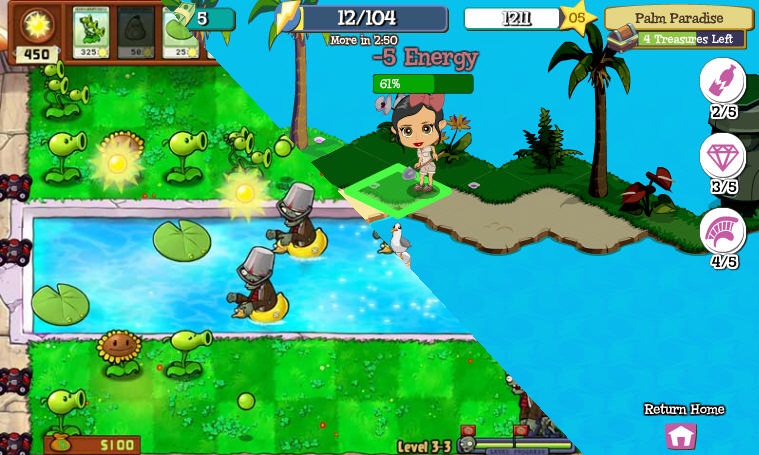
A case study: “Plants vs Zombies” and “Treasure Isle”
Let’s look at two casual games to see a correlation between the actions and the depth of gameplay. Plants vs Zombies (PvZ) has very few operational actions, simply selecting a plant and placing it on the game field. However it has a myriad of resultant actions that build upon this simple foundation. Plants interact in special ways that add emergence and depth (e.g. Torchwood doubles the damage of any peas that go through it). Rewards are given to the player (the death of more zombies) for discovering these resultant actions.
Treasure Isle on the other hand has few operational actions and few resultant actions. Players walk around the island digging up treasure. There is very little emergence or interaction that grows out of these operational actions. Rewards are given to the player for the operational actions. Players are not encouraged to dig deeper into the game but instead to simply open their wallets so they can continue to get the next reward for finding the next piece of treasure.
The Hypothesis
Both Popcap and Zynga games are popular. It is becoming apparent that much of Zynga, and other Facebook games, success is from the viral nature of Facebook rather than the quality of the game. My hypothesis is that bringing the depth and emergence of a game like PvZ to Facebook would see more success than the current round of shallow games we’re seeing. A game like PvZ would obviously need to be changed to fit with the social nature of Facebook, but the key is that giving a deeper player experience, as well as the means for virality is going to see greater success.
The Solution
I’ve looked at a number of casual games and the consistent thread between the successful games that have some depth is to:
Keep the operational actions low while maximizing resultant actions
The fewer operational actions a game has, the larger the market it can reach. While the more resultant actions a game has, the deeper the game experience. This fits in with the age old adage of “easy to play, difficult to master”. Players want to pick up a game quickly and not have to learn controls. This is perfect for Facebook games as they are primarily played with a mouse and one button. Resultant actions need to be layered on top of this simple set of operations actions in the best ratio possible.
Why the need to change?
With the huge success Facebook games have been seeing over the past years, why am I talking about changing the formula? The problem is that all the big Facebook games are seeing a drop in numbers. The biggest games are losing millions of players per month! To put that into perspective, many PC and console games are lucky to reach these kinds of numbers.
Why are they dropping off? The main reason is that Facebook has limited the ability for these games to send spam to the player’s friends. A big part of their success is the viral nature of Facebook. The game is more about convincing you to spam your friends than about convincing you that you’re having fun. These games need to get more depth quickly, or they will disappear as quickly as they grew.
An analogy for this is that terrible restaurant in the food court of the local mall. The food is terrible and however so many people go through the mall that even if people only go once or twice the restaurant will still always be full. What happens if suddenly they get moved to the back part of the mall where few people visit? They either make better food, or go out of business.
Conclusion
What are your thoughts on the current wave of casual games? Do you think it’s possible to add more depth to these games without comprising the casual nature of them? Is the Facebook game market already dying or is it just in need of some deeper games to bring it back?